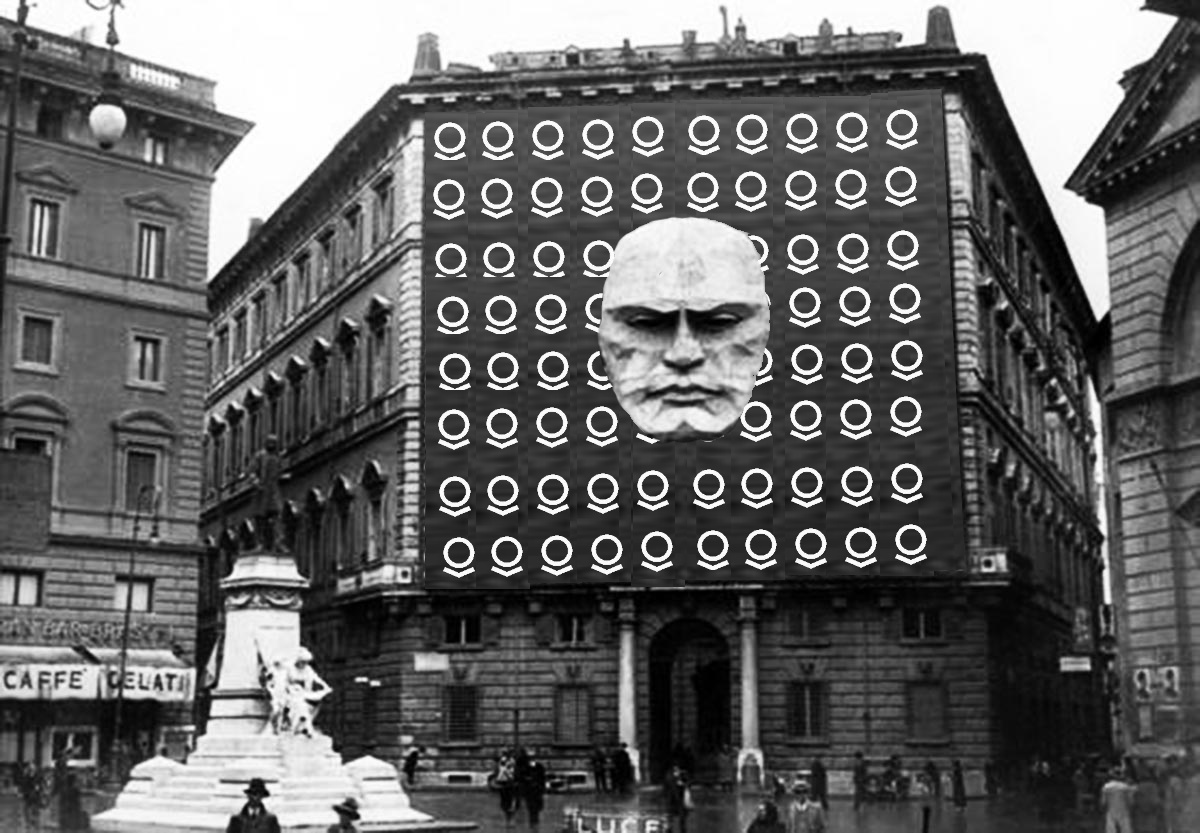
Did you know the founder of Palantir wrote a book? No, not the cartoonishly evil freak who rants about the antichrist. The other one, CEO Alex Karp. The Technological Republic came out last year, but yesterday, Palantir tweeted (thank you XCancel) a 22-point summary of it, and if you have any passing familiarity with history, sociology, or philosophy, it’s bafflingly horrible. One of the most powerful and opaque surveillance forces in the world that has deep hooks in the government is running on bigotry, fascism, and an absolute disbelief in anything most of us would consider individual or social morality. Let’s hit some highlights:
3. Free email is not enough. The decadence of a culture or civilization, and indeed its ruling class, will be forgiven only if that culture is capable of delivering economic growth and security for the public.
As a general rule, if a statement of beliefs or intentions mentions the decadence of a culture or civilization, the odds of it being fascist trash approaches 100%. Pining for a nostalgia-tinted past because of how great and strong your antecedents were is the most pathetic bitch-made stance you can take. Almost every generation tends to look at what the world was like when it were young through a lens of half-remembered pleasantness and outright mythology, and when that nostalgia becomes a driving force of your ideals and you start obsessing over performative masculinity and classical architecture, that’s when things start to go fascism-shaped. Culturally they’re all the same dance steps as the people who rallied under Mussolini and Franco.
4. The limits of soft power, of soaring rhetoric alone, have been exposed. The ability of free and democratic societies to prevail requires something more than moral appeal. It requires hard power, and hard power in this century will be built on software.
Soft power gave us a morally dubious but extremely successful global economic hegemony. Flexing our hard power and abandoning moral appeal is isolating us from the world. A big part of what makes societies and civilizations actually work isn’t constant, overt, and direct threats, but much wider and indirect pressures and influences to incentivize stability and growth. Morale doesn’t improve because the beatings continue. Seeing a need to keep hard power in the center of the room instead of something you tuck away in the cupboard but that everyone still knows is there is, in terms of political philosophy, a pure skill issue.
5. The question is not whether A.I. weapons will be built; it is who will build them and for what purpose. Our adversaries will not pause to indulge in theatrical debates about the merits of developing technologies with critical military and national security applications. They will proceed.
12. The atomic age is ending. One age of deterrence, the atomic age, is ending, and a new era of deterrence built on A.I. is set to begin.
I do think AI as it’s being pushed now is a very dangerous force, but these statements are hilarious in their self-importance. Unless you’re building Skynet or AM, how does AI deterrence even work? Nuclear deterrence functioned on mutually assured destruction, because the nuclear part of it openly threatened literal destruction. AI can potentially do a lot of horrible things if it can affect infrastructure or weapon systems, but by its nature it doesn’t physically do anything. It’s a technology that requires another apparatus to produce an effect. It isn’t a nuclear bomb, it’s a bomber jet. And because it’s indirect, it can be used while obfuscating the identity of who deployed it, making using it as a deterrent between states is even more ridiculous.
Yes, AI can be used for weapons. The dynamics of those weapons are nowhere close to what nukes were, in terms of hard or soft power.
And speaking of which…
14. American power has made possible an extraordinarily long peace. Too many have forgotten or perhaps take for granted that nearly a century of some version of peace has prevailed in the world without a great power military conflict. At least three generations — billions of people and their children and now grandchildren — have never known a world war.
Yes, largely because of the soft power you want to dismantle!
15. The postwar neutering of Germany and Japan must be undone. The defanging of Germany was an overcorrection for which Europe is now paying a heavy price. A similar and highly theatrical commitment to Japanese pacifism will, if maintained, also threaten to shift the balance of power in Asia.
I don’t think I need to say much here, except “We shouldn’t have disarmed Nazi Germany after WWII” is certainly a stance.
18. The ruthless exposure of the private lives of public figures drives far too much talent away from government service. The public arena—and the shallow and petty assaults against those who dare to do something other than enrich themselves—has become so unforgiving that the republic is left with a significant roster of ineffectual, empty vessels whose ambition one would forgive if there were any genuine belief structure lurking within.
Tell me you either went to Epstein’s island or have your own, somehow even more messed up island without telling me you either went to Epstein’s island or have your own, somehow even more messed up island.
20. The pervasive intolerance of religious belief in certain circles must be resisted. The elite’s intolerance of religious belief is perhaps one of the most telling signs that its political project constitutes a less open intellectual movement than many within it would claim.
21. Some cultures have produced vital advances; others remain dysfunctional and regressive. All cultures are now equal. Criticism and value judgments are forbidden. Yet this new dogma glosses over the fact that certain cultures and indeed subcultures . . . have produced wonders. Others have proven middling, and worse, regressive and harmful.
22. We must resist the shallow temptation of a vacant and hollow pluralism. We, in America and more broadly the West, have for the past half century resisted defining national cultures in the name of inclusivity. But inclusion into what?
You know what I said before about talking about the decadence of culture or civilization? This is just screaming out the fascist playbook. Rallying against conveniently vaguely defined “elites” (not the billionaires saying this, of course), upholding “some” (the ones they like or find useful) cultures as superior, condemning pluralism to make it clear that an “out” group is necessary and self-apparent, all of it. This is what fascism uses. This is what it does.
Also, the whole “more broadly the West” thing is the same fig leaf that the term “Judeo-Christian” provides in these discussions. The definitions are always expanded to seem more open, more flexible, less nakedly bigoted. It’s always the “West” until they can start peeling off each country and culture that’s no longer West enough for them and they need more enemies to rally against. Greece, Italy, Germany, Spain, Portugal, it’s amazing how small Western civilization gets to these people as soon as they don’t need to pretend they’re less hateful than they actually are. Similarly, any time you hear a politician talk about Judeo-Christian heritage, I guarantee you they will drop the Judeo part as fast as possible once their power is secured.
These people who are complaining about performative inclusivity are telling on themselves, and they know it. They know they have to pretend they aren’t the tiny, petty, bigoted creeps they actually are because their own campaigns of social engineering still haven’t done enough to keep their real, honest beliefs from alienating most people. Even this screed is couched in calculated ambiguity, and it’s so obvious and direct it would have been laughed out of any political discussion not 15 years ago.